Bank holiday changes to council services
Purpose of this pack
Brighton & Hove City Council Public Health has produced this pack to help ICTs reduce different types of fall risks and harms. It aims to support consistent high-quality activity across Sussex.
Different responses are needed depending on:
- how often people are falling
- the reasons for each fall
- the outcome and severity of each fall
The types of older residents are shown below. All require a response.
The actions in the pack are informed by:
- the NICE guideline
- recommendations from the falls workforce in Sussex
View this pack as PowerPoint slides
You can download this data and action pack as PowerPoint slides on our webpage, Brighton & Hove ICT falls data pack.
Understanding what is driving falls in our area
Types of older residents
We aim to reduce falls and fracture risks for all groups, including those who:
- have had no falls yet
- have had their first fall and are stable on their feet
- have had one fall and have difficulty walking or with balance
- need comprehensive assessment and management
Risk in the population
A national study found that 27% of people aged 60+ had a fall in the last year, of which one-third required medical treatment.
Prevalence of severe and non-severe falls in the last year by age and sex (English Longitudinal Study of Ageing Wave 8)
Men aged 60 to 69: No fall 80%, non-severe fall 15%, fall requiring medical treatment 4%.
Men aged 70 to 79: No fall 76%, non-severe fall 19%, fall requiring medical treatment 6%.
Men aged 80 and above: No fall 64%, non-severe fall 23%, fall requiring medical treatment 14%.
Women aged 60 to 69: No fall 74%, non-severe fall 18%, fall requiring medical treatment 8%.
Women aged 70 to 79: No fall 70%, non-severe fall 21%, fall requiring medical treatment 10%.
Women aged 80 and above: No fall 61%, non-severe fall 22%, fall requiring medical treatment 18%.
(Data: Estimate of non-falling 60+ population, ELSA Wave 8 applied to ICT population estimates, ONS).
West ICT
Applying these rates to the Brighton & Hove West ICT population in 2024, there may have been:
- 16,200 people aged 60+ who did not fall in West ICT last year
- 4,200 had non-severe falls
- 2,000 had a fall requiring medical treatment
Central ICT
In the Central ICT population in 2024, there may have been:
- 11,000 people aged 60+ who did not fall
- 2,800 had non-severe falls
- 1,300 had a fall requiring medical treatment
East ICT
In the East ICT population in 2024, there may have been:
- 13,400 people aged 60+ who did not fall last year
- 3,400 had non-severe falls
- 1,600 had a fall requiring medical treatment
Around 1 in 4 of these falls requiring medical treatment result in an emergency admission.
Types of falls and response
Emergency admissions are not a good proxy for overall fall rates or numbers because most falls do not result in an emergency admission.
Types of falls and responses
Falls not resulting in emergency admissions
- independent - individual can return to safe sitting independently
- carer or technology-enabled care response - support return to safe sitting, no 999 call required
People who have the above falls may not seek medical help or may be treated by GP, UCR, minor injuries unit or care home staff.
- ambulance response - hear and treat - telephone advice and referral to alternative service such as UCR, virtual wards and unscheduled care MDTs
- ambulance response - see and treat - face-to-face assessment without transport to a health-care facility, may result in referral to alternative service
- ambulance response - see and convey - day patients or A&E same-day emergency care
More than half of ambulance responses to falls are not conveyed to hospital.
Falls resulting in emergency admissions
Ambulance response - see and convey - falls injury admissions.
Other falls
Falls in inpatient settings.
Hotspots
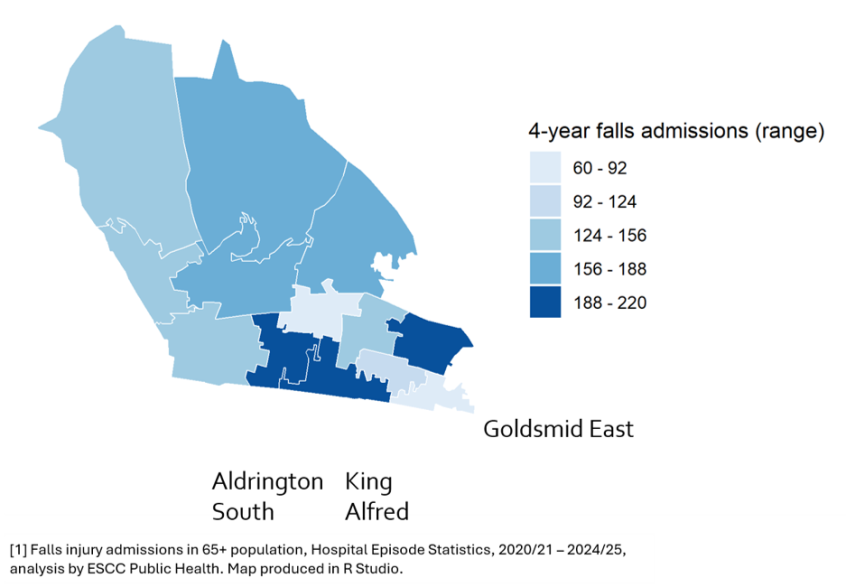
West ICT
The areas with the highest number of people aged 65+ admitted to hospital with fall injuries were:
- Aldrington South
- King Alfred
- Goldsmid East
Central ICT
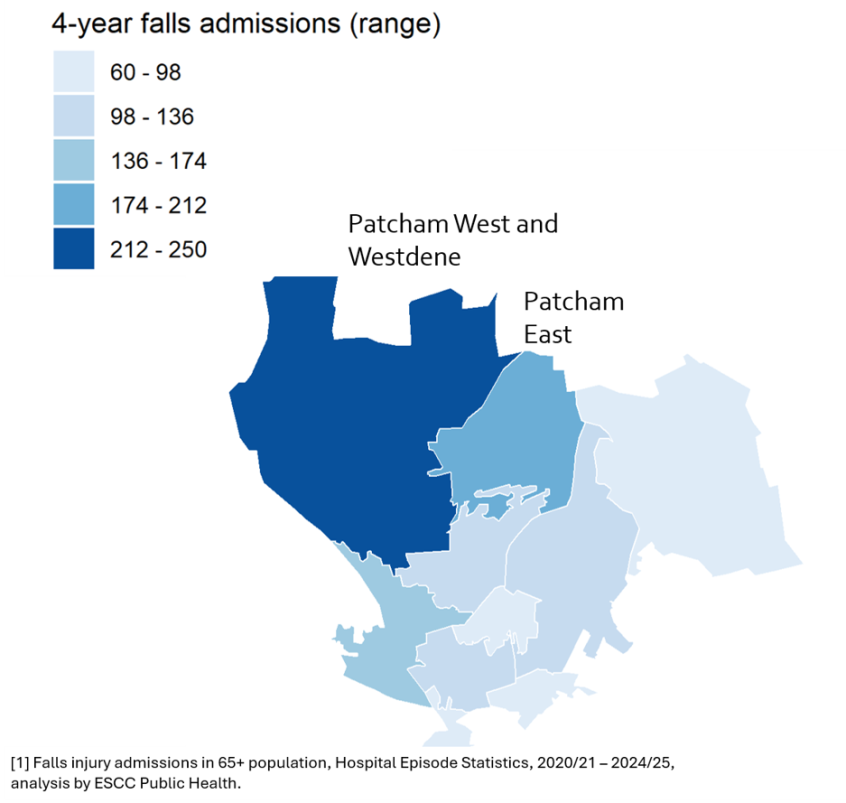
The 2 areas with the highest number of people aged 65+ admitted to hospital with fall injuries were:
- Patcham West and Westdene
- Patcham East
East ICT
The 2 areas with the highest number of people aged 65+ admitted to hospital with fall injuries were:
- Rottingdean & Saltdean
- Woodingdean
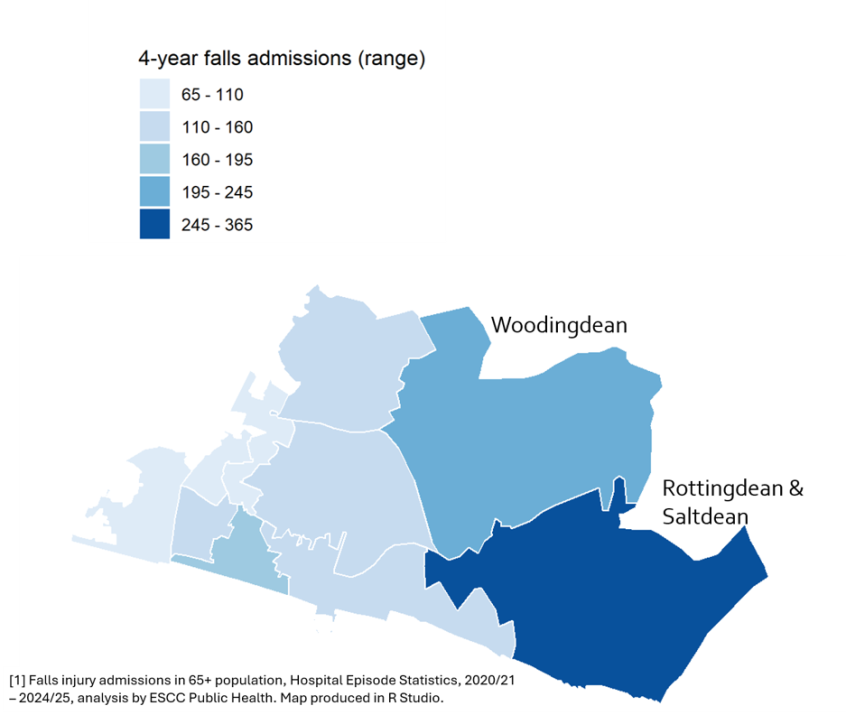
These areas may be suitable for geographically targeted interventions, such as placing a raizer chair in a community venue and training volunteers to allow safe pickup of residents who do not require conveyance to hospital.
Health Counts 2024
The Health Counts survey in Brighton & Hove showed that in adults aged 65 years and over, falls in the past year were highest in East ICT (31%). In Central ICT, this was 30%; in West ICT, this was 28%. For the city overall, this was 30%.
Adults aged 65+ years who had a fall in the past year by area, Health Counts 2024
| Area | Result | Compared to Brighton & Hove (over 65s) * |
|---|---|---|
| Brighton & Hove | 30% | - |
| West ICT | 28% | NS |
| Central ICT | 30% | NS |
| East ICT | 31% | NS |
*NS: not significant (the difference observed from the city figure may be due to chance). Note: for all respondents aged 18+, this is 19% at the city level.
Inequality – Brighton & Hove overall
For the city overall, among adults aged 65 and over, falls in the past year were significantly higher than the city figure (30%) in:
- those living in the most deprived 20% of areas nationally
- people who were deaf or partially deaf
- those with a long-term physical illness or health condition
- those with a mental health condition
- those with a physical difference
- those with sight loss
- disabled adults
Adults aged 65+ years who had a fall in the past year, by characteristic, Health Counts 2024
| Characteristic | Result | Lower 95% confidence interval | Upper 95% confidence interval | Compared to Brighton & Hove (over 65s)* |
|---|---|---|---|---|
| 65 to 74 years | 26% | 24% | 28% | NS |
| 75 to 84 years | 30% | 27% | 33% | NS |
| 85+ years | 43% | 38% | 48% | Higher |
| Black and Racially Minoritised | 35% | 30% | 41% | NS |
| White British | 29% | 27% | 31% | NS |
| Female | 34% | 31% | 36% | NS |
| Male | 25% | 22% | 27% | Lower |
| Trans, non-binary or intersex (TNBI) | 31% | 19% | 46% | NS |
| IMD quintile 1 (most deprived) | 36% | 32% | 41% | Higher |
| IMD quintile 2 | 31% | 27% | 36% | NS |
| IMD quintile 3 | 28% | 25% | 32% | NS |
| IMD quintile 4 | 28% | 25% | 32% | NS |
| IMD quintile 5 (least deprived) | 27% | 23% | 31% | NS |
| D/deaf or partially deaf older adults | 43% | 38% | 48% | Higher |
| Older adults with long-term physical illness/health condition (for example, cancer, diabetes) | 38% | 34% | 41% | Higher |
| Older adults with mental health difference/condition (for example, depression, schizophrenia) | 49% | 41% | 57% | Higher |
| Older adults with physical differences (for example, a condition limiting basic physical activities) | 47% | 43% | 52% | Higher |
| Blind and partially sighted older adults | 49% | 40% | 58% | Higher |
| Older adults with other conditions | 31% | 27% | 35% | NS |
| Older adults who are not disabled | 21% | 19% | 23% | Lower |
| Disabled older adults | 42% | 39% | 45% | Higher |
Where falls happen in Brighton & Hove
Of calls to the ambulance service for falls:
- 3 in 4 are from people living independently (74%)
- 1 in 5 are from people living in retirement housing schemes (19%)
- 1 in 14 are for care home residents (7%)
(Source: SECAmb responses to falls, October 2024 to 2025 by ICT area, analysed by WSCC Public Health.)
Of falls that result in emergency admissions:
- most are in people’s homes (58%)
- 17% are in an unspecified place
- 1 in 14 are in care homes (7%)
- 1 in 9 are on the street (11%)
- 7% are in another location
(Source: BCF Supporting Data Report by ICT area, 2023 to 2024, analysed by WSCC Public Health.)
Identifying people at risk of falls
All services coming into contact with people aged 65+ or aged 50+ with 1 or more factors that could increase their risk of falls should ask the following:
Have you fallen in the last year?
Then follow the NICE flowchart to ensure residents are triaged to the most appropriate service to address their fall risks.
Action we can take to reduce falls harms in our area
Key messages for the public
Ask if the resident has fallen
If yes, ask further questions to understand which services they should be referred to.
All residents aged 65+, and 50+ with conditions which increase falls risk, should be asked: Have you fallen in the last year?
If the answer is no, see messages below. If yes, follow NICE guidelines and triage to the appropriate service detailed in this pack.
Understand individual risk factors and encourage residents to address each risk factor
Medication review
Some medicines can make you more likely to fall. If you take any medicines that may increase your risk of falling, ask your GP or practice pharmacist to review them at your annual check-up.
Medicines that are most often linked to falls include:
- Central Nervous System (CNS) active medicines such as sedatives-hypnotics, opioids, antipsychotics, antidepressants, and anticonvulsants
- cardiovascular medicines such as antihypertensives, beta blockers, antiarrhythmics, and diuretics (water tablets)
- other classes such as anticholinergics, antihistamines, and NSAIDs
Vision check and cataract surgery if required – visit your optician for regular checks
Footwear and foot health – dispose of worn-out slippers and shoes
Move more, strength and balance
People should aim to take part in regular strength and balance activity at least twice weekly. Doing this in a group exercise session is more enjoyable for many and adds social benefits.
To find a local Strength and Balance class, phone the Ageing Well information, help and advice team on 0808 175 3234.
Online strength and balance exercises are available for older people with internet access. Adapted exercises are also available for many health conditions.
The Ageing Better website has further resources for professionals.
Activities evidenced to improve strength and balance are shown in Appendix 1.
Home environment safety - East Sussex Fire and Rescue Service
To book a home safety visit:
- book a home safety visit from the East Sussex Fire and Rescue Service online
- phone 08001 777 069
What to do if they have a fall, including how to get up, and when and how to seek help
Share the information and advice from the Association of Ambulance Chief Executives.
Watch the RSPA video on how to get up safely following a fall.
Reduce falls and fracture risks
Falls risk: alcohol use
Consider referring to the Brighton and Hove Recovery Service | Change Grow Live if appropriate.
Falls risk: visual impairment
To get a referral for a cataract assessment, consult your optician or GP.
Visit ESVS Home - East Sussex Vision Support.
Falls risk: Deaf/hearing loss
RNID provides face-to-face support at drop-in sessions across Brighton & Hove, help with using and maintaining your hearing aid, information about deafness, hearing loss and tinnitus, and support to check your hearing.
Visit RNID Near You: our local support services - RNID.
Falls risk: stroke
The Stroke Association hosts group exercise online for all mobility levels following a stroke.
Visit Online Stroke Activities | Stroke Association.
Falls risk: dementia
The Memory Assessment Service helps people experiencing memory problems find out what’s going on and access the right treatment and support.
The service offers both clinical and social support and can be accessed via a GP.
Visit Brighton & Hove Memory Assessment Service.
Falls risk: Parkinson's
Parkinson's UK offers many local groups and exercise classes.
Visit Find support near you | Parkinson's local support finder.
Falls risk: learning disability
You can get help from the Specialist Community Disability Service (SCDS) if you have a learning disability, are age 18 or over and live permanently in Brighton & Hove.
The SCDS can help people with learning disabilities make choices, increase their opportunities, and access services and the local community.
Visit our webpage for help if you have a learning disability.
Falls risk: Osteoporosis
All residents should consider Vitamin D supplements, particularly during winter.
Sussex MSK Health provide advice on Osteoporosis and whether residents need a DEXA scan.
Osteoporosis is one of the criteria for assessment by the Falls and Fracture Prevention Service.
One fall - impaired gait and balance
Improve strength, balance and mobility
The Ageing Well information, help and advice team can speak to individuals and/or professionals about local opportunities to improve strength, balance and mobility.
You can find strength and balance activities on the Ageing Well website.
Stay safe at home
East Sussex Fire & Rescue Service
The East Sussex Fire & Rescue Service will carry out a free home safety visit available via self or professional referral.
To book a home safety visit:
- book a home safety visit from the East Sussex Fire and Rescue Service online for you or someone you're supporting
- phone 08001 777 069
CareLink Plus
CareLink Plus is Brighton & Hove City Council’s telecare alarm service.
Telecare describes a range of services and equipment that allow you to call for help in an emergency. This could be in or outside the home. Telecare can increase your independence and help you feel safe.
For more information, you can:
- visit our CareLink Plus alarm and telecare service webpage
- phone 0300 123 3301
- send an email to CareLinkPlus@brighton-hove.gov.uk
Support to remain at home following a fall
Urgent Community Response (UCR) supports patients to remain in their home (usual place of residence) to avoid attendance and/or admission to an acute hospital. GPs oversee UCR patients and can access physiotherapy, occupational therapy and medication reviews.
Sussex Community NHS Foundation Trust provides the Urgent Community Response (UCR).
UCR accepts referrals from patients and carers, voluntary services and health and social care professionals.
Comprehensive assessment and management
Falls and Fracture Prevention Service (provided by Sussex Community NHS Foundation Trust)
This is a non-urgent service for adults who meet 3 or more of the following:
- over 75 years of age
- multiple falls in the past 12 months
- falls at home
- previous fracture over the age of 50
- diagnosed osteoporosis
- significant fear of falling
Patients with a neurological condition can be more appropriately assessed and reviewed by a specialist service such as the Community Neurological Rehab Team.
Referrals are accepted from health and social care professionals, voluntary agencies and can be made by:
- phoning OneCall on 0300 3737 111
- sending an email to sc-tr.onecallwsreferrals@nhs.net
Discharged from hospital following a fall
People can be referred to the Falls and Fracture Prevention Service; see referral details above.
Living with frailty
Proactive care of residents living with frailty
GPs can refer residents to multidisciplinary teams.
Frailty Same Day Emergency Care (SDEC)
Frailty SDEC provides a rapid assessment and treatment for older people with frailty, including identifying and reducing falls risk.
Settings
Setting: housing associations
Falls prevention
The Royal Society for the Prevention of Accidents produced a toolkit for housing associations to systemically reduce falls risk. ICTs can contact Housing Associations in their area to discuss using this toolkit.
Setting: care homes
Falls prevention
Comprehensive risk factor assessment and management should be undertaken for all residents in care homes.
Action Falls is the gold standard for reducing falls in care homes. The programme uses a train-the-trainer model. A Falls Lead completes Action Falls training (£150 per person, 5 hours).
Find out more about the Action Falls programme on the University of Nottingham website.
The Falls Leads provide training and support to care homes.
Each care home nominates a falls champion.
The Action Falls checklist is used to assess and manage each resident’s falls risk. The checklist is added to their digital care record.
Find out more about the Action Falls Toolkit on the NIHR website.
Setting: hospital inpatients
Falls prevention
Comprehensive risk factor assessment and management should be undertaken for all patients in hospitals.
Interventions should be tailored to promptly address any falls risk factors.
At discharge from hospital, consider referring the person to community services to address risk factors identified during their hospital stay that are also relevant at their discharge destination.
Conduct a structured medication review.
Encourage people to remain active during their hospital stay.
Read recommendations from the National Institute for Health and Care Excellence (NICE).
Download resources from the repository of all resources produced by the National Audit of Inpatient Falls (NAIF).
Appendix 1
Strength and balance
The table shows the types of physical activities most effective for improving muscle function, bone health and balance, noting that walking is not evidenced to improve balance.
Further advice for professionals is available on the Centre for Ageing Better website.
Type of sport, physical activity or exercise: running
Improvement in muscle function: low effect.
Improvement in bone health: medium effect.
Improvement in balance: low effect.
Type of sport, physical activity or exercise: resistance training
Improvement in muscle function: strong effect.
Improvement in bone health: strong effect.
Improvement in balance: medium effect.
Type of sport, physical activity or exercise: aerobics, circuit training
Improvement in muscle function: strong effect.
Improvement in bone health: strong effect.
Improvement in balance: medium effect.
Type of sport, physical activity or exercise: ball games
Improvement in muscle function: medium effect.
Improvement in bone health: strong effect.
Improvement in balance: strong effect.
Type of sport, physical activity or exercise: racquet sports
Improvement in muscle function: medium effect.
Improvement in bone health: strong effect.
Improvement in balance: strong effect.
Type of sport, physical activity or exercise: yoga, tai chi
Improvement in muscle function: low effect.
Improvement in bone health: low effect.
Improvement in balance: low effect.
Type of sport, physical activity or exercise: dance
Improvement in muscle function: low effect.
Improvement in bone health: medium effect.
Improvement in balance: low effect.
Type of sport, physical activity or exercise: walking
Improvement in muscle function: low effect.
Improvement in bone health: low effect.
Improvement in balance: no effect.
Type of sport, physical activity or exercise: Nordic walking
Improvement in muscle function: medium effect.
Improvement in bone health: not known.
Improvement in balance: medium effect.
Type of sport, physical activity or exercise: cycling
Improvement in muscle function: low effect.
Improvement in bone health: low effect.
Improvement in balance: low effect.