Bank holiday changes to council services
Recognising the vital role of Parking Officers
Find out more about 'Beyond the Uniform', a campaign to transform perceptions of Parking Officers.
About the 'Beyond the Uniform' campaign
In July 2024, the Parking Enforcement Team received funding from PATROL (Parking and Traffic Regulations Outside London) to create an impactful campaign addressing the abuse faced by Parking Officers.
This initiative, which secured joint winner status alongside the North Essex Parking Partnership (NEPP), was commended for its “creative and thought-provoking” approach to educating the public about the essential work of Parking Officers.
Read more about the Beyond the Uniform campaign on the PATROL website.
The campaign's goals
The campaign aims to transform how the public perceives parking officers by:
- humanising the role by sharing personal stories and dispelling common myths
- highlighting their contribution by demonstrating the critical part they play in maintaining the city’s flow
- fostering understanding of their work’s value to the community
A call for respect and understanding
This campaign invites the public to reconsider their perceptions of parking officers. By sharing their stories and celebrating their contributions, we hope to build a community that recognises and respects the vital work these individuals do for us all.
Watch the documentary-style short film 'Beyond the Uniform'
With funding from PATROL and in collaboration with the NEPP, the Parking Enforcement Team has produced a documentary-style short film, 'Beyond the Uniform'. This engaging video shares the real stories behind the uniforms, illustrating the human side of enforcement, and emphasising their dedication to keeping the city running smoothly.
The documentary will premiere on our social media channels and be featured at high-profile city venues, including the Amex Stadium, ensuring it reaches a broad audience.
The 'Beyond the Uniform' video can be viewed below.
Supporting materials for the campaign
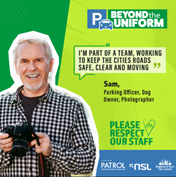
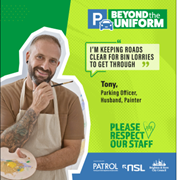
In addition to the video, a variety of supporting materials have been created for social media and print. These resources highlight the important role Parking Officers play, and focus on breaking stereotypes by emphasising the people behind the job.
Our enforcement contractor, NSL, will display campaign livery on their vehicles, showcasing support for the initiative.
Blue light agencies, such as the police and ambulance service, have also provided testimonials highlighting the essential role parking officers play in maintaining safety and accessibility across the city.
Examples of supporting materials

|
|

|

|
||

|
|

|
How we'll measure the success of the campaign
The statistics below show the level of abuse experienced by Parking Officers over the last 5 years.
According to NSL, 2024 statistics showed that 53% of the abuse suffered was not related to a Parking Officer issuing a PCN or observing a vehicle.

The yellow line shows verbal attacks, including:
- profanity
- interactions that were aggressive in nature
- interactions that were hateful/personal, such as wishing harm to the person or their family
It shows a big increase from 2023 (21) to 2024 (44).
The red line shows physical attacks (any form of intentional physical contact). It shows a small increase from 2023 (14) to 2024 (18).
We'll be measuring the success of this campaign by collating statistics in line with the campaign launch to see the levels of parking officer abuse decrease.
If this campaign is successful, it will be rolled out across the country, helping drive change nationally.
Misconceptions about parking officers
Parking officers do not receive bonuses or commissions for issuing tickets. They're paid a fixed salary, and their focus is on ensuring compliance with parking regulations and maintaining public safety.
Parking enforcement is designed to encourage compliance, improve traffic flow, and enhance road safety. Any surplus from parking fees is legally required to fund transport and highways-related services, such as concessionary travel and supported bus services.
How Parking Officers enforce restrictions
Parking Officers enforce council-set restrictions based on clear guidelines. Observation periods are required before issuing tickets, and handheld devices prevent tickets from being issued without meeting these criteria. It’s the driver’s responsibility to check signage and park correctly.
The wider role of Parking Officers
Parking Officers contribute to public safety, the local economy, and the city’s well-being. Beyond enforcement, they assist the public, provide directions, and are often the first to respond to incidents, ensuring the city remains safe and accessible.
Charity and community work
Brighton & Hove City Council's parking enforcement contractor is committed to working with charities. This includes:
- raising funds to aid local organisations that provide essential services for those experiencing homelessness
- actively supporting dementia awareness campaigns, including fundraising for Memory Walks, and being recognised as an Age and Dementia Friendly Business for their commitment to inclusivity and understanding
They also regularly take part in beach cleaning.
How Parking Officers support the local community
Examples of when Parking Officers have assisted people whilst out on their patrols:
A Parking Officer helped a person with a mild form of Muscular Dystrophy open their car door. The car was parked on a slope, and the person was having trouble opening the door. The person was very thankful and stated that had the Parking Officer not been there, they would have had to turn the car around and let gravity do the work.
A Parking Officer was patrolling a car park and witnessed a vehicle reverse and hit a car, causing damage. The driver hadn’t realised they had caused damage and started to drive away. The Parking Officer stopped the driver and advised them to leave a message for the car owner.
A Parking Officer came across an unwell person in the street. The person seemed very confused and didn’t know where they were. The Parking Officer phoned an ambulance and waited with them until it arrived.
A Parking Officer helped a disabled person to find the correct department at the hospital for their appointment. The Parking Officer went into the reception and explained the situation, and the person was given emergency treatment.
Two parking officers, together with a member of the public, stopped a car from causing an accident as the vehicle suddenly started to roll down the road.